

ParityKnow the test that owns the file.
A release gate for matched coverage: connect each production file to its belonging test, then prove the relationship in CI.
A release gate for matched coverage: connect each production file to its belonging test, then prove the relationship in CI.
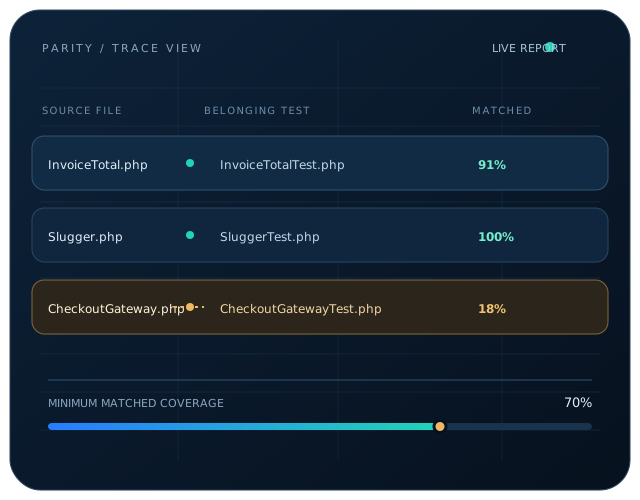
The missing relationship
A global percentage can look healthy while the test that belongs to one file barely exercises it. Parity keeps the useful context together: source file, owning test, matched lines, and the rule that decides whether the proof is enough.
3 files / 3 ownersInvoiceTotal.phpInvoiceTotalTest.php91%passSlugger.phpSluggerTest.php100%passCheckoutGateway.phpCheckoutGatewayTest.php18%review! The suite may pass. The owning test still needs more proof.
A small addition to your existing workflow
Parity reads the report your test tool already produces. When that report cannot identify tests individually, parity test can run them one at a time and build the per-test evidence that parity check evaluates.
Map source folders to tests, or use static ownership links from Pest and PHPUnit.
Use Parity JSON, PHPUnit XML, Clover, or Cobertura when the tool already records attribution.
Run each test through parity test to create one report per test in a stable directory.
Fail with the file, its belonging test, matched percentage, and the threshold that was missed.
quickstart / existing test commandready$ composer require --dev testparity/parity
$ php vendor/bin/parity init
# Let Parity generate per-test reports when the coverage tool cannot.
$ php vendor/bin/parity test
# Check every source/test relationship in CI.
$ php vendor/bin/parity check --format=json
PASS 18 files mapped / 16 owners proven / 2 review itemsThe contract
A rule is only useful when a reviewer can see what it protects. Keep the threshold next to the source/test map.
min_matched_coverage: 70

structure:
  - name: Services
    paths:
      source: app/Services
      test: tests/Unit/Services
    rules:
      - test-exists
      - matched-coverage:
min: 70The result a reviewer needs
JSON is made for CI. Table output is made for a human scanning a failed merge. Both carry the same local proof, so a release failure is actionable instead of another number to investigate.
Explore output and rules ->parity check --format=json1 failure{
"source": "app/Services/CheckoutGateway.php",
"test": "tests/Unit/Services/CheckoutGatewayTest.php",
"matched_coverage": 18,
"minimum": 70,
"error": "matched coverage is below minimum"
}Proof across real stacks
The public samples are small on purpose. Each repository installs Parity in CI, produces coverage, runs the check, and documents the difference between global coverage and the coverage attributable to one test.
Browse the sample repositories ->Parity checks its own ownership rules, publishes a PHAR, and keeps the docs and implementation specs together.
Read the source ->